

Many SMB owners face daily disputes, complex systems, and rising refund demands that can distract from business growth.
- They often rely on computer systems and software that don't talk to each other.
- There is a growing problem of friendly fraud, when a customer makes a valid purchase, but later disputes the charge with their bank. As none of these purchases are considered unauthorized by the cardholder, the chargebacks negatively impact merchants in both cost and time spent responding to the false claim.
- SMBs sometimes accidentally block a real customer because they look a little suspicious, called a false decline. It’s estimated that by 2027 businesses will lose more than $264 billion globally1 from rejecting valid orders. Optimizing this balance—stopping the bad guys while letting the good guys in—is critical for survival.
- The way a business handles these disputes can make or break its reputation. If a customer has a legitimate dispute and the store takes weeks to fix it, that customer might consider shopping somewhere else in the future. Fast resolution is the key to keeping people happy. By moving away from slow, manual processes and using smarter tools to solve problems quickly, businesses can build trust and retain their loyal customers.
What are chargebacks?
Dispute: When a customer challenges a transaction, prompting the issuer to reverse funds from the merchant and investigate the case to see if the claim is valid.
Chargeback: Think of a chargeback as a request to undo a charge on a transaction following a dispute, when the issuer and the bank step in to investigate and potentially reverse the payment.
Chargebacks can happen for several reasons, including fraud, unrecognized charges or processing errors.
Chargeback versus refund: The main difference here is who starts the process. A refund is initiated by the customer with a merchant, while a chargeback is started by the customer but with their card issuer instead of the merchant. If a merchant gets too many chargebacks, it can also damage its reputation with their financial institution.
Friendly fraud: This happens when a customer disputes a legitimate purchase they made, approved, or that someone in their household made. This can include forgotten subscriptions, confusion over a billing descriptor, or claims involving goods that were received. These disputes can cost merchants time and money and may increase their chargeback rate.
How do chargebacks work?
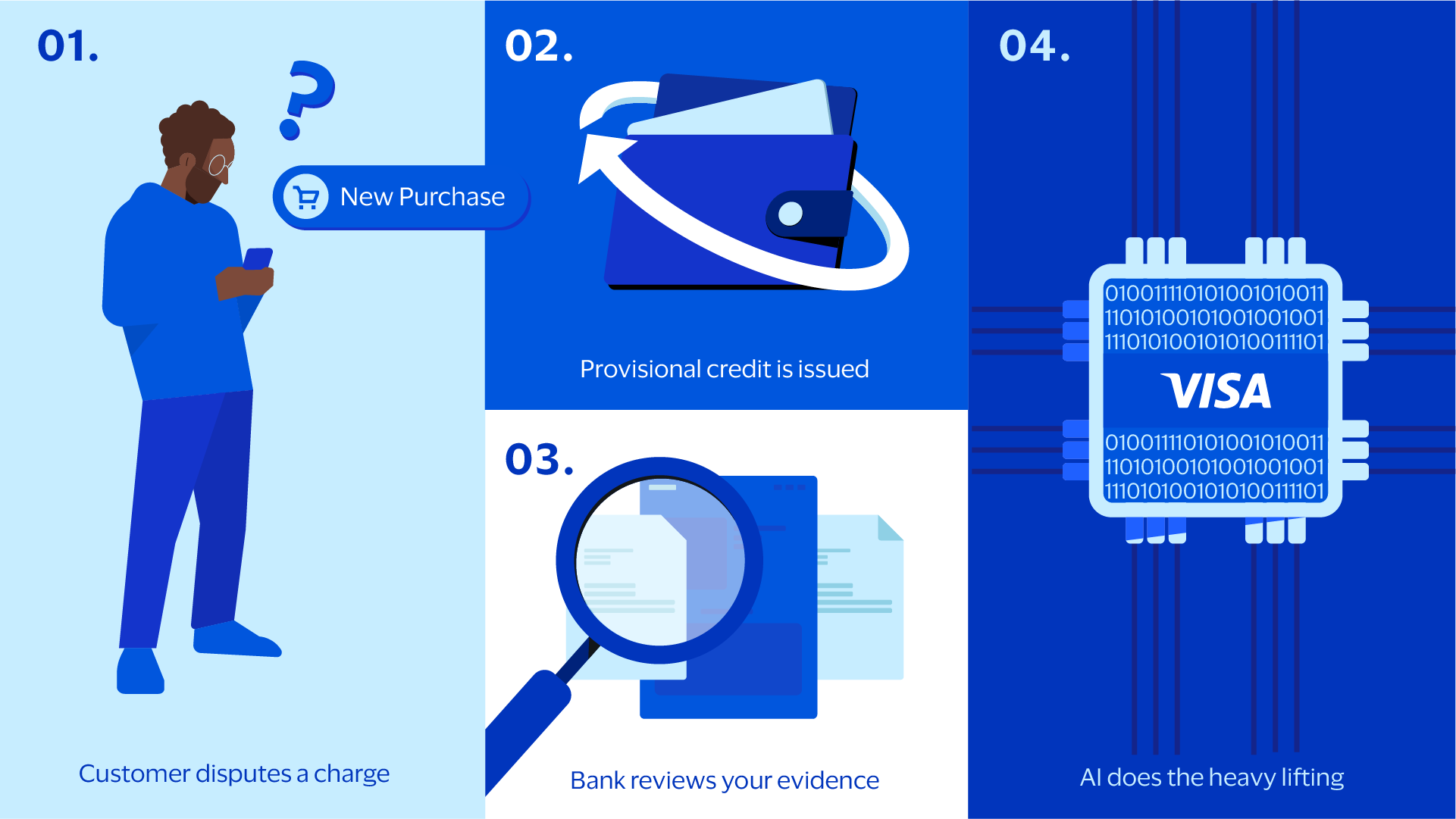
1. Starting a dispute: When a customer checks their bank statement and sees a charge they don’t recognize, they’ll contact their issuer to start a dispute.
2. The issuer steps in: The issuer takes the money back from the merchant and gives it to the customer temporarily, called a provisional credit. Then the merchant gets a notification asking them to prove the sale was valid. Merchants must offer compelling evidence, like a delivery tracking number or a signed receipt, to show the issuer that they delivered what was ordered.
3. The final decision: The issuer looks at the evidence from the merchant and decides if it proves that the transaction was legitimate or not. Should the evidence satisfy the issuer’s criteria then the SMB wins—however, if they lose then this is particularly hard because the SMB loses the sales money and must pay a penalty fee to the issuer for the trouble.
4. AI to support: Merchants can use modern tools powered by AI to automatically spot suspicious claims and speed up evidence sharing to reduce manual work. This replaces slow paperwork with fast digital decisions, letting merchants focus on their business.
What can you do about chargebacks?
Businesses can effectively manage and reduce chargebacks by combining clear billing practices to prevent customer confusion with advanced, automated fraud detection tools that stop unauthorized transactions before they happen.
Bridge the online-offline gap: When customers buy something online but pick it up at the store, there’s a greater chance of refund misuse or non-receipt claims, which are growing problems for SMBs. When the customer is there for pickup, an online order becomes a safer card-present transaction.
Use clear billing descriptors: Unclear merchant billing descriptors can cause confusion that can lead to disputes. To reduce the likelihood of this happening, merchants should make sure their business name and information are recognizable in their billing descriptors so that their information is clear to customers on their card statements. Customers in that case are far less likely to get confused and file a dispute for a legitimate transaction.
Automate management: Many businesses are moving away from checking every order manually, using automated tools to do the heavy lifting. These automated systems can screen orders instantly and handle dispute paperwork automatically. This helps SMBs save money on staffing costs and focus on selling cool products rather than digging through piles of digital paperwork.
Leverage EMV 3-D Secure: EMV 3-D Secure checks to make sure customers are who they say they are when they are making an online purchase by authenticating the customer during an online purchase. This layer of security also gives merchants fraud liability protection providing liability shift for certain eligible fraud-related disputes.
Identify patterns: Businesses use reporting tools, like the Fraud Details Report, to show patterns and indicators, like if a sudden spike in fraud is coming from a specific country or using a certain type of card. By spotting these trends early, store owners can quickly adjust their security rules to block those specific attacks and keep their business safe.
Stop fraud before it happens: Advanced Fraud Detection Suite (AFDS) from Authorize.net helps protect your business without slowing checkout down. It uses customizable rules—like checking addresses, card codes, fast repeat purchases and risky locations—to catch and block suspicious orders in real time. You can choose whether a flagged order is blocked, sent for review or allowed. With AFDS, you spend less time dealing with chargebacks and more time serving customers.
| Bridge the online-offline gap | Use clear descriptors | Automate management | Leverage EMV 3-D Secure | Identify patterns | |
|---|---|---|---|---|---|
| The problem | Refund misuse (“friendly fraud”) is when a person buys something online but picks it up at the store—then tells their bank they didn’t. | Transaction descriptor confusion is when a customer sees a purchase on their bank statement they don’t recognize, one of the most common causes of disputes. | Many businesses are moving away from checking every order by hand, using automated tools to do the heavy lifting. | This industry standard checks to make sure customers are who they say they are when shopping online with their card, by asking for a code or password. | Businesses use special reporting tools, like the Fraud Details Report, to spot fraud trends or indicators. |
| The solution | Stores can check to see if it’s the original shopper at pickup, to help spot potential fraud. | To stop transaction descriptor confusion, businesses need to make sure their business name and information appears clearly on the customer’s bill. | Automated systems can screen orders instantly and handle disputes without the need for manual intervention. | This layer of security gives merchants fraud liability protection. | These tools show if a sudden spike in fraud is coming from a specific country or using a certain type of card. |
| The result | This turns a risky online order into a safer card-present transaction, which is much more likely to be approved and valid. | If the name on the statement is clear, customers are less likely to get confused and file a dispute. | This helps SMBs save money on staffing costs and lets them focus on their business instead of digging through piles of digital paperwork. | If a hacker does manage to make a purchase, the bank takes responsibility for the loss instead of the merchant. | By spotting these trends early, merchants can quickly adjust their security rules to block those specific attacks and keep their business safe. |
What does Visa offer?
Visa Dispute Case Manager: Visa Dispute Management Services (which includes case management) puts all the information related to a dispute in one centralized place and uses automated workflows to fill out forms and other manual tasks, helping resolve disputes faster.
Acceptance Devices: By using a unified commerce device that requires customers to tap their card when they pick up your order, the transaction is considered card-present. These transactions are very secure, making it harder for bad actors to commit fraud.
Advanced Fraud Detection Suite (AFDS): Built into Authorize.net, this combination of powerful rules, filters and tools watches over suspicious CNP activity like high-velocity orders and shipping-billing mismatch. AFDS is designed to help online merchants identify, manage and prevent costly fraudulent transactions, and includes a whole array of tools that work together to examine transactions for any signs of fraud.
Visa Advanced Authorization: Every time merchants take a card payment, this AI system analyzes the transaction in milliseconds. It looks for emerging fraud patterns and checks if the purchase fits the customer’s normal habits. It assigns a risk score to the transaction instantly. If the score is too high (meaning it looks like a scam), it blocks the transaction immediately. This helps approve good orders while keeping fraudsters out, all in real time.
Chargebacks can happen for all sorts of reasons—not just fraud. Authorize.net’s tools take the pain out of the process, by helping you spot scams, clear up customer confusion and tackle time-consuming admin.
How do businesses use Visa’s chargeback solutions?
Blackhawk Network
The global branded payment technology company wanted to transform its disputes process to better meet its goals and save time and money. Visa helped them reduce agent training time from four weeks to just a week and handle more disputes without hiring more staff.
SoftPoint
This fully integrated hospitality management system partnered with Visa to help restaurants fight friendly fraud on pickup orders. With Visa’s help, it implemented solutions that had customers tap their card upon collection of their food, which helped secure revenue and simplified the pickup experience.
Razorpay
Cross-border CNP transactions present a fraud risk to businesses that require effective mitigation while allowing good customers to shop seamlessly. Razorpay saw an 18% reduction in false positives and a 40% decrease in chargebacks for cross-border CNP transactions by using Visa’s robust risk management tools.
Harley-Davidson
The legendary American motorcycle manufacturer and lifestyle brand needed a fraud management solution that would help it to transact quickly, safely and reliably across multiple territories. By choosing Visa, the brand was able to grow its online sales by selling across nine countries while keeping chargebacks to a minimum.
FAQs
Small businesses train staff to spot friendly fraud, which happens when a customer makes a valid purchase but later disputes the charge with their bank. Employees learn how to collect compelling evidence for each order, such as saving delivery tracking numbers, keeping records of customer conversations and checking that the billing address matches the shipping address. They are also trained to spot suspicious orders early—like if a customer places a large order for the same high-value item—so the business can review or cancel the order before it turns into a chargeback.
The key differences are intent and evidence. Legitimate disputes usually involve clear merchant errors, such as incorrect items, billing mistakes or non-delivery due to shipping issues. Friendly fraud often shows red flags like confirmed delivery, previous successful purchases from the customer and matching device or login data. Reviewing transaction data, delivery confirmation and customer history helps businesses distinguish between the two.
Some chargebacks are caused by confusion rather than fraud. Customers may not recognize a transaction descriptor on their bank statement, forget a purchase, or believe contacting their card issuer is faster than reaching the merchant. Clear billing descriptors and purchase insights, easy-to-find refund policies, and tools like digital receipts can prevent disputes before they escalate into chargebacks.
Small businesses have to watch their chargeback ratio closely: that’s the percentage calculated by number of chargebacks divided by total transactions. They can use digital dashboards provided by their payment partners to see how many sales are turning into disputes. They can also look at reports that show exactly why transactions failed or why customers complained. By keeping an eye on these numbers, a business owner knows if they need to turn on stricter security settings or stop accepting orders from certain risky places to protect their profits.
Compliance requirements are set by card networks such as Visa and Mastercard. Among other things, fraud, disputes and enumeration levels are monitored to identify entities over thresholds that may require risk-mitigation steps.
Yes, a merchant can dispute a chargeback, a process known as “representment”. First, the merchant looks at the reason code for why the chargeback was made and then gathers evidence that supports their case, like photos of the item being delivered or the IP address of the device used to make the purchase. The merchant then submits a rebuttal letter and evidence to the acquiring bank by a strict deadline. Some chargebacks are fraud, so it’s important to have good response strategies in place, as well as fraud prevention measures to help you spot bad actors. However, some chargebacks are difficult or impossible to reverse, depending on the reason code and authentication used.
If you want to prevent disputes—and minimize friendly fraud—before they start, tools like Order Insight offer detailed transaction information that can help you manage friendly fraud, while helping genuine customers recognize confusing transactions on their statement. This approach means you can deflect disputes early, while reducing confusion and deflecting disputes before they escalate into chargebacks using historical and linked purchase data.
Yes, some chargebacks can be reversed with compelling evidence. Once a merchant has completed the representment process, they must await the bank’s decision. If successful, you will receive the money back into your account. In order to get a chargeback ruled as invalid or fraudulent, swift action is key: it means gathering data and other evidence to support your claim. Fraudsters deliberately target small and medium-sized business owners who may not have the resources to fight claims quickly, which is why using technology often puts you at an advantage where you are better prepared to win.
A payment gateway (like Authorize.net) links the merchant, the customer, the issuing bank, the acquiring bank and the card network (such as Visa) to authorize transactions. Beyond just processing online and card-not-present sales securely, modern payment gateways offer robust tools for centralized transaction management, reporting and billing. While physical stores often rely on a POS system and processor, digital gateways are the essential backbone for secure online checkouts.
The timeline for accepting customer payments largely depends on the approval speed of your chosen payment gateway and whether you already possess a merchant account, which is required for processing credit cards. If you have a merchant account, setup can be incredibly fast: platforms like Authorize.net can provide auto-approvals upon a successful application, allowing you to begin processing transactions in just minutes after updating your gateway parameters. However, if you are starting from scratch, be aware that establishing a new merchant account might take up to five business days, depending on factors like your credit history, industry type and application responsiveness.
An acquiring bank, or acquirer, is a financial institution that acts on behalf of your business within the payment ecosystem. Its primary role is to process and settle payments made by your customers via their issuing bank. The acquirer facilitates complex communication between you and major card payment networks like Visa to ensure funds are properly routed.
While you are not obligated to use acquirer bundling to process payments, an all-in-one package is often a quicker and easier way for new businesses to get started. In the past, merchants typically sourced a payment gateway, a merchant account and payment processing services from separate vendors. Today, payment service providers offer streamlined bundled solutions, though keeping services separate may better suit a business that already has an existing merchant account. Providers like Authorize.net give you the flexibility to choose, offering bundled options that can often be auto-approved quickly, or allowing you to integrate their gateway independently with your current merchant setup.
Start accepting payments today
1 Datos Insights. (August 2024). The Future of E-Commerce: Innovations to Protect and Enrich the Online Channel [https://globalclient.visa.com/datospaper]
Disclaimer: Case studies, comparisons, statistics, research, and recommendations are provided “AS IS” and intended for informational purposes only and should not be relied upon for operational, marketing, legal, technical, tax, financial or other advice. Visa neither makes any warranty or representation as to the completeness or accuracy of the information within this document, nor assumes any liability or responsibility that may result from reliance on such information. The information contained herein is not intended as investment or legal advice, and readers are encouraged to seek the advice of a competent professional where such advice is required.